Toward a Post-Cartesian World
Is the Modern era coming to an end? If so, what might the era-to-come look like?


“But we do know, not as the angels know and not as dogs know but as men who must know one thing through the mirror of another”—Walker Percy in Symbol and Existence
Part I: The Aim of Saints, Scholars, & Starships
Hello dear Reader! Welcome (or welcome back) to Saints, Scholars, & Starships.
After a few months of writing here consistently, I finally have a mission statement for this publication!
The purpose of Saints, Scholars, & Starships is this: to explore what religion, philosophy, & technology may look like in a post-Modern-era world.
As I hope to show in a minute, it appears to me that we may soon be at the end of the Modern era, which one could say began with the Protestant Reformation in 1517 and was formalized in philosophy by Descartes in the early 1600s. Further, assuming we do not all get nuked into oblivion in the next few years (would it be too much to ask that we do not, please?), there is a reasonable chance that a genuinely post-Cartesian (meaning, after Descartes), post-Modern era may be on the brink of appearing. This would likely involve a tectonic change in how we all view, well, everything frankly! The post-Modern age may be as different to the Modern era as the Modern era was to the ancient and medieval worlds, or even more so. In this essay, I would like to briefly discuss the trajectory of philosophy up til now, the task of our current moment, and a faint outline of what a philosophy-to-come may look like.
Part II: Philosophy’s Past to Philosophy’s Present
Very succinctly, one can summarize the history of philosophy so far in this way. The premoderns were, on the whole, Realists—a technical term meaning that they believed that there is a Reality that exists independently of us and that we could know this Reality. This included physical reality, such as the world of rocks and trees and stars, but also things such as moral and aesthetic reality. Just as a stone exists whether or not anyone thinks about it, so they too would have said that certain actions are intrinsically right or wrong, independent of human thought. The fact that, say, murder is wrong, was just as real and as “objective” a fact as the Sun emitting heat. Lastly for now, they believed in general that to truly know something was to conform your mind and will to it. To know that 2 + 2 = 4 was in a way to conform your mind to that fact. To truly know that stealing was wrong meant to conform your will to this and not steal anything. The premoderns then, summarizing a quote from the great C. S. Lewis (author of The Chronicles of Narnia), sought to conform their mind and will to Reality, and this they did via virtue.
The moderns, in contrast, have in general been Idealists—a technical term meaning that we never know Reality directly, but only our Ideas about Reality. This means in practice that we cannot know anything as it is—say, a rock, for instance—but only our impression of the thing. This is how we approach moral and aesthetic reality as well. If we see a movie, we don’t believe we can say that it is a good movie in-and-of-itself, but only that we think it is a good movie. We don’t believe we can say that a waterfall is “objectively” beautiful, but only that we think it is beautiful. Since we cannot truly know anything that exists independently of us, the only things we can know for certain are the things we make ourselves. We can never trust in something like Divine Revelation, for instance, because this originates outside of us and is therefore something we cannot be sure of. We can, however, understand things such as rocket ships because we in fact build them. For the moderns, to make something is the only way to know it—the only world we can know is the world we make. In contrast to the premoderns, then, we moderns aim to conform Reality to our mind and will; and this we do via technique.
As discussed in God & The Great Filter, the premoderns wanted to be Saints, and the moderns long to build Starships. In a way, these are opposite aims—as the former involves conforming our will to Reality, and the latter involves conforming Reality to our will—but must they be opposing? Might we be both virtuous and technical? Could we be Saints and build Starships? Could the post-Modern era in philosophy somehow reconcile the premodern aspiration with the modern one? Is this the great task of our time?
Part III: The Fourth Turning
Perhaps!
But why today, specifically? Why might the post-Modern era in human thought be on the brink of appearing soon, and not just in the remote future?
I believe a new era could emerge over the next few years in particular because we seem to be at the end of two important epochs. The first is the end of the Modern era in philosophy. It has run its course over the last few hundred years, and though there have been good fruits from it, it is essentially incomplete and not up to the task of helping us navigate the world of today. Specifically, though it is almost a cliche at this point, we have indeed thrown out ancient wisdom in the pursuit of modern knowledge, and—given our turbulent politics and technological powers—pure survival and necessity call us today to figure out a way to reconcile the two.
Secondly, we seem to be at the end of an 80-year cycle in U.S. history in which monumental structural changes in our culture, institutions, and beliefs may rapidly take place in the very near future. Bill Strauss and Neil Howe, in their book The Fourth Turning, observed that over the course of American history, every 20 years or so (or one generation’s length of time), our society has gone through a change that mimics the natural cycle of Spring to Summer to Autumn to Winter. The authors refer to each of these societal seasons as a Turning, with Spring being the First Turning all the way through Winter as the Fourth. As Strauss and Howe predicted, we are presently, as of 2024, in a Fourth Turning, and great changes are likely to take place in our country very soon as a result.
One could say that the last Fourth Turning—or societal Winter—in the U.S. was roughly around the 1930s and -40s, during which the Great Depression and World War II occurred. As we emerged triumphantly from the war, we found ourselves in a cultural Spring—a First Turning—in the late 40s through 60s era. During this time, government actually functioned (!), and grand projects such as the interstate system and getting us to the moon were undertaken and completed. American universities were the best in the world during this period, and other institutions, such as media companies, were established and, on the whole, healthy (this was the Walter Cronkite era of news). The Civil Rights movement made great progress, and serious efforts toward racial equality were made. Following this era was the Summertime period of the 70s and 80s, the Autumn era of the 90s and 00s, and the Winter period which began around the start of the 2010s. We are, as of 2024, still in this season and have roughly 5 to 10 years left to go.
During our current Winter era, this Fourth Turning—in sharp contrast to the Spring era of the -50s and -60s—our government is largely inept and embarrassing (I am not holding my breath waiting for high-speed rail networks to be built in the U.S. over the next 5 years); our political discussions are pitiful (as I write, the nation is arguing vigorously over whether people are eating cats in Ohio, as well as whether a huge amount of people are illegally crossing our border every day or only a very large amount); our universities are shamefully expensive and face increasing competition from those in places such as Singapore and Beijing; and so forth.
There is good and bad news regarding all of this. The bad news first. There are likely a few years of Winter left, and unfortunately, every Fourth Turning in U.S. history has ended with an extremely serious war. The American Revolutionary War took place around 1780; then, in the 1860s, about 80 years later, was the American Civil War; and about 80 years after that, in the 1940s, we entered World War II; and we find ourselves now, about 80 years after that, living in the 2020s.
It is not certain that war is coming—some winters are more mild than others, after all. That said, we really are living in a perilous moment, to put it mildly. This actually is as dangerous a time as you might imagine, and there are many, many ways this can all go extremely South, extremely quickly. More people were killed last century than in all previous ones combined, so it is not unreasonable to say that the next 5 to 10 years could be the deadliest in our country’s history, and perhaps that of mankind as well.
If there can be any silver lining in this, it is that if we do make it to the other side of this Fourth Turning—God willing—there may be a genuine Springtime: an era in which new institutions can be made and old ones renewed, a time hopefully of more peace and overall sense of unity. There are many things that are impossible now which may become possible then. Whether the winter is intense or mild, and regardless of whether or not we make it through this Turning, it is our responsibility now to consider how we wish for Springtime to unfold and who we want to be—perhaps even who we need to be—going into that Springtime.
This Fourth Turning may not just be the end of this 80-year cycle in American history, but perhaps the end of the Modern era, too. It is up to us—and might I suggest God as well—to determine what the era-to-come may look like!
Epilogue: A Possible Shape of The Era-to-Come
I would be an unkind writer indeed if I simply told you that the world as we know it is collapsing all around us and did not provide so much as a hint of what a hopeful future could look like.
I shall be brief here and only focus on philosophy, as the purpose of this whole publication is to explore what shape the post-Modern era may take, so other essays from Saints, Scholars, & Starships will probe more specifically into various topics.
I hold that the foundations for a truly post-Cartesian, post-Modern era in philosophy were laid by Charles Sanders Peirce in the late 1800s and early 1900s. He is considered by many to be the most intelligent American who ever lived (and the more I read from and about him, the more I begin to see why).
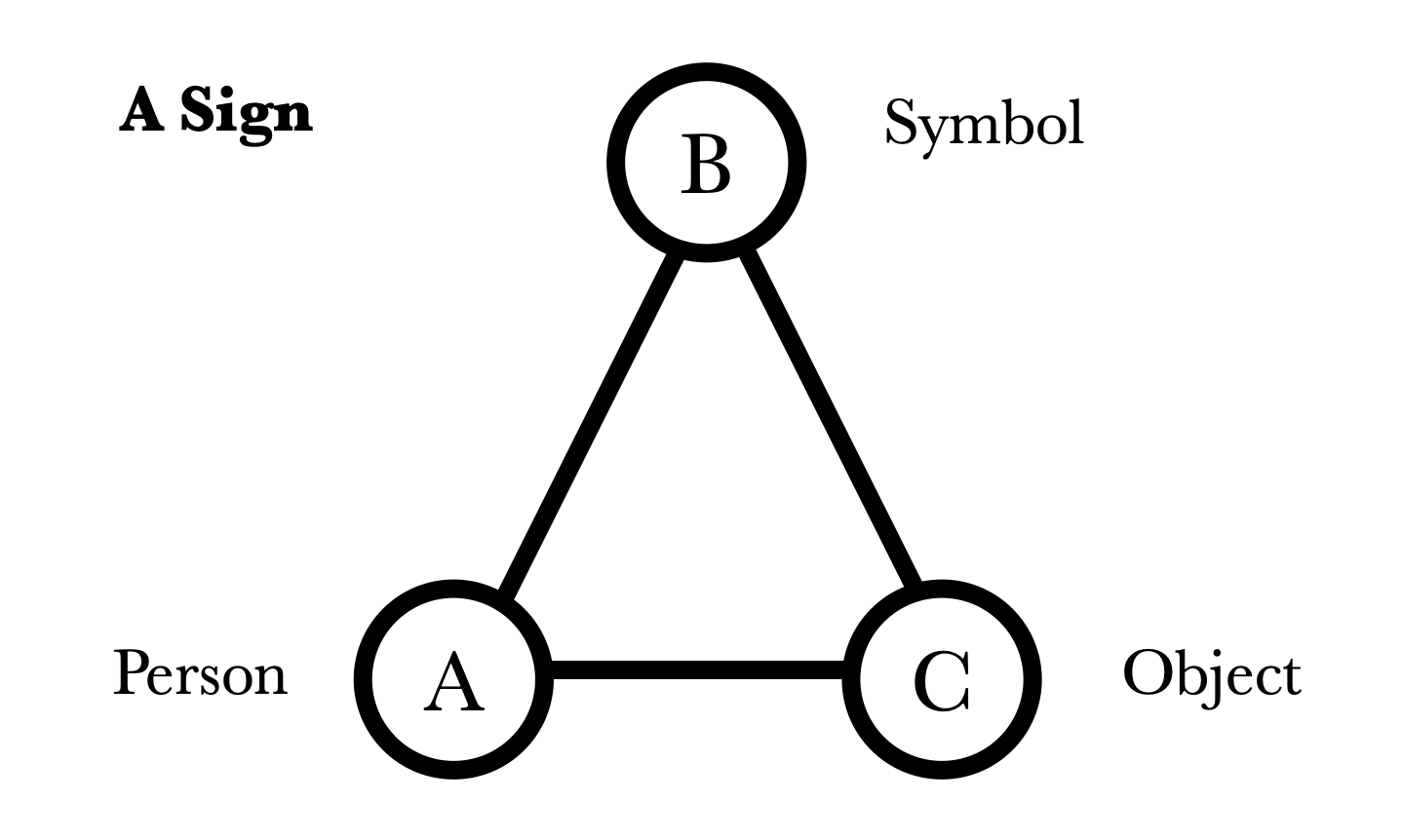
In particular, it is his doctrine of Signs—which he describes as the irreducibly triadic relation between a person, object, and symbol—that makes me believe his philosophy will help us reconcile the best of the premodern and modern worlds. For the object in a Sign can be a mind-independent entity (such as a rock, which exists whether or not anyone believes it is there), and this mind-independent aspect of Reality is what the premoderns focused on and prioritized. On the other hand, the symbol in a Sign is something that is mind-dependent (such as the word-symbol ball), and this mind-dependent aspect of Reality is what the Moderns have emphasized and revered. As Peirce states, all of our thought is in Signs, and it is precisely the Sign where mind-independent Reality meets mind-dependent Reality.
Charles Peirce laid the groundwork for this philosophy, known as semiotics, and we have before us now an opportunity to develop it. There are many other factors that will go into building a post-Modern-era world, but I believe regarding philosophy, Charles Peirce will have the first word (but certainly not the last!).